My trip to Kura's Air Pilot Training event in Stratford-Upon-Avon
I finally arrived at 10 to find an array of well dressed gentlemen, this included pilots from various airlines. There is a general buzz in the room as we wait for the 'show' to begin! I feel somewhat underdressed, suits and pilot badges shine over the coffee cups adorning the room.
Standing in the auditorium, it draws your eyes towards the stage. The Kura logo is splashed up high, with mist looming amongst the beams of light. There is an array of stands from flight companies, all ready to get you into the air.
Piles of pens are calling me. A 20p pen with a logo on it can make my day. The biggest thumbs-up right now, is seeing some 10-16 year olds attending. I can't help but feel that had the ease of access to apps such as Event-Bright existed n my teens, perhaps I would have followed this career! I would have liked to see more youngsters embracing the knowledge that this presentation had to offer!
Speaking to the chaps at Virtual Aerospace, their passion for flight simulation is inspiring. Finding out that they build fully integrated cockpits is amazing, and may see me head out for a try one day.
There are so many challenges to pilot training, watching the speakers talk about their careers should push even the most academically shy of people to have a go. This key part of the day focussed on enjoying the overall aspects of being a pilot. The love for flying clearly shines through, though I can't help feel that STEM groups from local school could have had some time here.
What came from this though, was that jobs in aviation, like many industries, are buoyant for periods of time. Landing on the right moment can really help career prospects and starting the progression towards your goal. A useful addition was an answer to a question about the selection processes for training. Personal skills are important! The message was simple, with 30% fail on first time aptitude tests, don't give up. A knock back isn't the end!
The training aspects were very interesting, the key message: Stay away from cheap Type-Rating promises! Just because they offer 500 hours flight time, the door likely awaits you at its conclusion. The prospect of flying on other continents as a means of adding hours was a great one. The cost is a staggering outline though, moving upwards of 50-60k!
They talked about the rosters and the life of a pilot. With the overall use of automatic systems, they answered the ultimate question: Is it really as glamorous? It is evident that it is! The need for new pilots in the near future is substantial. The Magic-8-Ball isn't likely to be needed very soon. With ambition and determination, the path is ready to walk down.
The BA Cityflyer initiative was one to take note of. They are progressing with a rolling program for First-Officers. With a frozen qualification, you can apply for a place. With a bonded 2-year type rating, this is great for those who are ready! Being ready is vital, making your way through the qualifications early is a clear move in the right direction.
The companies here are all offering a way of life. The idea of a career is embedded though, with only the whispers of what expenses should befall you.
With literature in hand, some more pens and a memory stick, I need to find a way of bridging this event with schools! How can we move these ideas, inspiration and experiences into the Primary field? Drawing children towards the idea of flight being closer than they may ever think is the primary goal here! Where there is aptitude with dreams, there is possibility.
All in all a keen event. I was told that it was Kura's first one of these. It was good to see a variation of vendors, all with a goal to get you into the sky, be it real or virtual. As a veteran of flight simming, I would like to have seen more presence from the community, this might have been a good time to own a Fly UK badge.
With the stage set, it is time to bring these together. As engineering firms are grasping onto opportunities in schools, it is time for the air-bound industries to come and play too.
A special mention to Hana from Take Flight, she gave me the answer to my question, and it was before I had to leave for my train! Watch this space as I may be able form the connection that I have been hoping for.
How do you feel about flight? Does it scare you? Are you like me, entangled in a loving relationship with the thought of flight, whilst awaiting the time you might grab a set of real controls?
Tuesday, 29 November 2016

The Cold Station Theory
As I stand on the platform at Stafford Station, I remember how cold and lonely train stations really are. It's a brisk morning with dark skies. I am bound by the hat and gloves that keep me cosy, holding jack frost away from my delicate hands and noggin.
It doesn't seem to matter how many times I have been on a train, it still amazes me how quiet it is. Even sitting on the train, it has the same ear popping hum of a plane coming in to land. There's always one thing that you can count on though, a hot drink. One to heat you back up and help you remember that there are warmer climbs!
So, I wonder why. What is it that makes it like that?
We should think about the general reason for the stations in the first place. Like bus stations and airports, people have a goal. Their eye on that target is held throughout. Only the conversational expert might chat to those around them, finding people who can share their love of trains, planes and, possibly, automobiles.
With that goal, we become single-filed-in-mind, one track (excuse the pun) to the destination. What separates the train system from an airport though, is that the platforms don a baron wind-tunnel look and feel, the odd coffee vendor can be found selling their wares. That explains the cold and damp though, I seriously doubt that the national rail network will start putting doors on the end of platforms anytime soon.
There's evidence of making things better though, look at city stations, they have malls attached to them, sprawling shops linked to an ever growing metropolis.
As cities get bigger, so will airports! What about our trains, let's try to make it a little more homely. I just wish i knew how!
I am currently on my way to Statford-Upon-Avon, going to a pilot training talk and a means of research for my STEM group later in the year.
What's your take on transport hubs, is commuting a sorry endeavour all of the time, given that going to work in the cold is never a 'cool' choice? Take care!
It doesn't seem to matter how many times I have been on a train, it still amazes me how quiet it is. Even sitting on the train, it has the same ear popping hum of a plane coming in to land. There's always one thing that you can count on though, a hot drink. One to heat you back up and help you remember that there are warmer climbs!
So, I wonder why. What is it that makes it like that?
We should think about the general reason for the stations in the first place. Like bus stations and airports, people have a goal. Their eye on that target is held throughout. Only the conversational expert might chat to those around them, finding people who can share their love of trains, planes and, possibly, automobiles.
With that goal, we become single-filed-in-mind, one track (excuse the pun) to the destination. What separates the train system from an airport though, is that the platforms don a baron wind-tunnel look and feel, the odd coffee vendor can be found selling their wares. That explains the cold and damp though, I seriously doubt that the national rail network will start putting doors on the end of platforms anytime soon.
There's evidence of making things better though, look at city stations, they have malls attached to them, sprawling shops linked to an ever growing metropolis.
As cities get bigger, so will airports! What about our trains, let's try to make it a little more homely. I just wish i knew how!
I am currently on my way to Statford-Upon-Avon, going to a pilot training talk and a means of research for my STEM group later in the year.
What's your take on transport hubs, is commuting a sorry endeavour all of the time, given that going to work in the cold is never a 'cool' choice? Take care!
Wednesday, 16 November 2016
Movement - From A to Z without the fuss!
Can we really create movement without energy? Not really, energy is always required from somewhere. Whether it is from a power cell or from the sun's rays, it has to be drawn from somewhere.
My point for this post is quite simple, can we make it 'less'? Imagine that in ten years Toyota creates a motor that is able to use 50% less fuel in their cars. With hybrid engineering, this could allow an engine to travel twice, if not thrice the distance on a single tank.
This technology is getting better, and with the move to more sustainable energy options, we could see a time that we continue to use oil-based fuels, spread over more years than what we currently have available. Imagine spreading the oil we still have access to from the 50 years left at the moment, to another 200 years. Aside from the environmental impact, both positive and negative, the engineering prospects would be fascinating.
The negative consequences can be looked at another time. For now, though, let's look closely at the aspects of cutting the energy needed to move an object. I am going to break this down into the '5-Ways' of energy options first:
Way One: Oil-Based Combustion
A quick run through of how this works first. The fuel that is drawn from crude oil, in this case we'll look at gasoline, is mixed with air and then exploded to push sequenced cylinders down, thus turning a central bar. This turn is what is used to move the wheels, often via a transmission that contain several cog sizes. This makes the engine run faster or slower rotations based on their size.
Now that is done, simple, but I believe effective, we can see that it is not only old fashioned to some extent, but also messy. It doesn't take a genius to know that oil is mucky!
How are they solving the amount that is used? Although we could look at the hybrid concept, I want to look at the oil-based part only. Engineers have been able to create carburetor units that, with the help of other units fixed to the motor housing, will reduce the flow, and therefore, need for the fuel. Advances in efficiency with bearings and heat distribution can all make a difference too. What is the future for this technology?
Way Two: Hydrogen Fuel Cells
Sticking with cars and other wheeled-vehicles on this one, the concept, and now, reality of Hydrogen as a fuel has come a long way. With only water as a by-product, it is far cleaner than using oil.
The idea of this will allow there to be a truly sustainable form of energy that could power more than just wheeled vehicles. There is little to support the use of it as a power source for electricity in a home, but with further development, could this be an answer to power shortages around the world. Even if it was only a backup for now, it might be welcomed by many New Yorkers, i'm sure they would prefer that than another hefty black-out.
Way Three: The Wind
Okay, I don't mean the kind from the dark side, the kind that wisps past our faces in the great outdoors. Using the wind for power has been around for some time now, we have seen a big rise in turbines on grassy hills, on our coastal vistas and even on the deck of sail boats.
Talking of sailing boats, we know how the wind causes their movement, do we not? The gust will push the large area of the 'sail' along, thus pushing the hull through the water. There is more to this though, the keel acts like an under-wing to the sail's over-wing. When you discover that air is just like water, you can understand this better. Our nitrogen rich air is very thick! It rolls over the hills and your head, like a tidal flow in the ocean.
Thus, the sail and keel are like a aeroplane's wings but in liquid as opposed to the air. Even though this is a little off-track, it does beg the question of whether we could learn from these similarities, though, this might already be the case.
Way Four: You
'Wheels' it is again! The bicycle has been around for a long time. The Bone-Shaker was a French designed early idea of the two-wheeled frame that we have today.
Looking at the pedal rotation on a modern bike, we use our energy, made from what we eat and drink, to rotate a central wheel that drives a wheel at the rear to move you along. This, of course, is not the only way that we move objects along. As well as Fred Flintstone's epic running-powered rock-car, and the use of hand-cycles, we also move objects with our body heat. Though this is small, it is energy that could be harnessed. Maybe?
Way Four: Unknown Technology from...'THE FUTURE'
So this is a cop-out I know, but really, what could you make in the future? This is the 'People in the Shed' aspect again. That's it really, is there another way of moving things? Solar energy is a great technology. There are fossil-fuels used for steam engines, what about coiled springs? This was an idea that I had a while ago...
Bonus: My Idea
My first concept was based on the use of a coiled spring. Like a 'pull-back' car from the toy chest, what if we could harness the energy that can be stored in a flexible material was used to power rotation of a wheel?
That brings me onto now. I was thinking about the use of hand-launched drones in the military. If we launch the vehicle first, air pressure maybe, this would improve the fuel economy. Fuel? What is the fuel in this case? The coil's 'potential' energy is what! So, the 'potential' might be there, are you ready to get in that shed?
What do you think? What do you know? Is this a 'debunk-able blunder'? This could go on for a long time, I haven't even touched on gravity as a force for movement! Tally-ho!
 |
| Movement - Nice lights! (All-Free-Download.com) |
My point for this post is quite simple, can we make it 'less'? Imagine that in ten years Toyota creates a motor that is able to use 50% less fuel in their cars. With hybrid engineering, this could allow an engine to travel twice, if not thrice the distance on a single tank.
This technology is getting better, and with the move to more sustainable energy options, we could see a time that we continue to use oil-based fuels, spread over more years than what we currently have available. Imagine spreading the oil we still have access to from the 50 years left at the moment, to another 200 years. Aside from the environmental impact, both positive and negative, the engineering prospects would be fascinating.
The negative consequences can be looked at another time. For now, though, let's look closely at the aspects of cutting the energy needed to move an object. I am going to break this down into the '5-Ways' of energy options first:
Way One: Oil-Based Combustion
A quick run through of how this works first. The fuel that is drawn from crude oil, in this case we'll look at gasoline, is mixed with air and then exploded to push sequenced cylinders down, thus turning a central bar. This turn is what is used to move the wheels, often via a transmission that contain several cog sizes. This makes the engine run faster or slower rotations based on their size.
Now that is done, simple, but I believe effective, we can see that it is not only old fashioned to some extent, but also messy. It doesn't take a genius to know that oil is mucky!
How are they solving the amount that is used? Although we could look at the hybrid concept, I want to look at the oil-based part only. Engineers have been able to create carburetor units that, with the help of other units fixed to the motor housing, will reduce the flow, and therefore, need for the fuel. Advances in efficiency with bearings and heat distribution can all make a difference too. What is the future for this technology?
Way Two: Hydrogen Fuel Cells
Sticking with cars and other wheeled-vehicles on this one, the concept, and now, reality of Hydrogen as a fuel has come a long way. With only water as a by-product, it is far cleaner than using oil.
The idea of this will allow there to be a truly sustainable form of energy that could power more than just wheeled vehicles. There is little to support the use of it as a power source for electricity in a home, but with further development, could this be an answer to power shortages around the world. Even if it was only a backup for now, it might be welcomed by many New Yorkers, i'm sure they would prefer that than another hefty black-out.
Way Three: The Wind
Okay, I don't mean the kind from the dark side, the kind that wisps past our faces in the great outdoors. Using the wind for power has been around for some time now, we have seen a big rise in turbines on grassy hills, on our coastal vistas and even on the deck of sail boats.
Talking of sailing boats, we know how the wind causes their movement, do we not? The gust will push the large area of the 'sail' along, thus pushing the hull through the water. There is more to this though, the keel acts like an under-wing to the sail's over-wing. When you discover that air is just like water, you can understand this better. Our nitrogen rich air is very thick! It rolls over the hills and your head, like a tidal flow in the ocean.
Thus, the sail and keel are like a aeroplane's wings but in liquid as opposed to the air. Even though this is a little off-track, it does beg the question of whether we could learn from these similarities, though, this might already be the case.
Way Four: You
'Wheels' it is again! The bicycle has been around for a long time. The Bone-Shaker was a French designed early idea of the two-wheeled frame that we have today.
Looking at the pedal rotation on a modern bike, we use our energy, made from what we eat and drink, to rotate a central wheel that drives a wheel at the rear to move you along. This, of course, is not the only way that we move objects along. As well as Fred Flintstone's epic running-powered rock-car, and the use of hand-cycles, we also move objects with our body heat. Though this is small, it is energy that could be harnessed. Maybe?
 |
| Do the colours make a difference? (All-Free-Download.com) |
Way Four: Unknown Technology from...'THE FUTURE'
So this is a cop-out I know, but really, what could you make in the future? This is the 'People in the Shed' aspect again. That's it really, is there another way of moving things? Solar energy is a great technology. There are fossil-fuels used for steam engines, what about coiled springs? This was an idea that I had a while ago...
Bonus: My Idea
My first concept was based on the use of a coiled spring. Like a 'pull-back' car from the toy chest, what if we could harness the energy that can be stored in a flexible material was used to power rotation of a wheel?
That brings me onto now. I was thinking about the use of hand-launched drones in the military. If we launch the vehicle first, air pressure maybe, this would improve the fuel economy. Fuel? What is the fuel in this case? The coil's 'potential' energy is what! So, the 'potential' might be there, are you ready to get in that shed?
 |
| Are you still 'droning' on? (All-Free-Download.com) |
What do you think? What do you know? Is this a 'debunk-able blunder'? This could go on for a long time, I haven't even touched on gravity as a force for movement! Tally-ho!
Wednesday, 2 November 2016
Bringing STEM Based Learning to Everybody.
The Fight Begins
We are a race of creators, builders, people that like to put two and two together and find out how to make it five. With the ever burdening reality that 'stems' from our need for more engineers, it is now that we need to bring new ideas for luring candidates into the fold.
I have been interested in 'everything' for as long as I can remember. You name it, I like it. Okay, so there are some things that don't float my boat, cricket for instance, I have never been able to get on with that sport, though strangely enough, I have always been able to bowl at a reasonable level. I have talked in previous posts about some of the things I enjoy, sometimes this leads to conflicts though, so it isn't all fun. I have mentioned the love of VR, its practical innovations have tickled me since the early 90s. Although the concepts of it were extinguished by the mid-90s, the modern resurgence of technology is showing that there are possibilities for it in our future.
It has long been my thought that VR could open up a gateway to more than just data or gaming applications. Whether it is used to teach building in a virtual environment, or perhaps utilising it for training surgeons, I believe that it has a place in education, if not many other aspects of life. What if, it could be used for emotional well-being? Could it be used to calm autism? The headsets would need to be less intrusive in this field, but the possibilities are there. The concept of Microsoft's Lens is intriguing. This allows you to create an AR (Augmented Reality) platform, placing the virtual items and scenery like a projection onto the real world. This would allow an open view for claustrophobia or those with difficulties in close proximities.
What are the options then? With a modern headset, it is easy to get drawn into the virtual scenery. I have made myself nauseous from spinning around in a sand buggy. whether it was graphically well defined or not, it fooled my brain anyway.
I have placed the applications into three distinct groups:
We are a race of creators, builders, people that like to put two and two together and find out how to make it five. With the ever burdening reality that 'stems' from our need for more engineers, it is now that we need to bring new ideas for luring candidates into the fold.
I have been interested in 'everything' for as long as I can remember. You name it, I like it. Okay, so there are some things that don't float my boat, cricket for instance, I have never been able to get on with that sport, though strangely enough, I have always been able to bowl at a reasonable level. I have talked in previous posts about some of the things I enjoy, sometimes this leads to conflicts though, so it isn't all fun. I have mentioned the love of VR, its practical innovations have tickled me since the early 90s. Although the concepts of it were extinguished by the mid-90s, the modern resurgence of technology is showing that there are possibilities for it in our future.
It has long been my thought that VR could open up a gateway to more than just data or gaming applications. Whether it is used to teach building in a virtual environment, or perhaps utilising it for training surgeons, I believe that it has a place in education, if not many other aspects of life. What if, it could be used for emotional well-being? Could it be used to calm autism? The headsets would need to be less intrusive in this field, but the possibilities are there. The concept of Microsoft's Lens is intriguing. This allows you to create an AR (Augmented Reality) platform, placing the virtual items and scenery like a projection onto the real world. This would allow an open view for claustrophobia or those with difficulties in close proximities.
What are the options then? With a modern headset, it is easy to get drawn into the virtual scenery. I have made myself nauseous from spinning around in a sand buggy. whether it was graphically well defined or not, it fooled my brain anyway.
I have placed the applications into three distinct groups:
- Create and Build: Use the virtual environment to produce items for certain jobs, puzzle building and solving, materials and design aspects.
- Environmental Awareness: The virtual scenery could be used to apply happiness routines. It could allow for the user to experience calm or even seclusive scenarios.
- Anywhere, Anytime: Fulfil fantasies, send the user to places they may never visit in their lifetime. Move beyond the bounds of economic or mental insecurities.
These three areas are the start of more to come. These can almost be seen as my own 'Rules of Virtual Engagement'. Watch this space. I wonder where I should begin?
Let me know your thoughts on VR and AR implementation. Could it help you in anyway? How would it effect our everyday lives, might it create an affect on the current social issues that digital technology is causing? For now, we can only speculate and debate.
Friday, 21 October 2016
One Way that We Could Change Society

The big difference, is that many people don't really care about how they are sleeping, or whether they are getting enough of it. Athletes, however, watch their sleep patterns. They monitor each 90 minute cycle from the silicon bracelet that adorns their wrists. With that, the question is about whether we SHOULD care.
What if, in a world that runs this fast, we all started to watch our own sleeping patterns? What would lead from this? There would, no doubt, be some startling effects that might just change how we live, altogether. Let's look at the common traits that cause us to have poor sleep in this societal maze.
One - Diet
It is no secret that what we eat will make a difference to our moods and resting patterns. You only need to see a 5-year-old that has eaten a load of Halloween candy to prove that! What is the answer to this though? If we were only to eat vegetables, we wouldn't survive.
If we look at the bright side though, imagine a world that was mindful of their diet. Nothing but the nutrition that was needed. This would, though, be boring, it was okay not to have a load of sweet stuff when sugar was rare. Now though, we have a western addiction to such pleasures.
We can't just stop at candy though, we also love drinks that hold less nutrition than a stone. Look at all the coffee that is being consumed! The caffeine claims its grip on humanity.
Two - Entertainment
We are bound by the laws of enjoyment! Watching TV, playing games, reading a good book, these are all factors that entertain us, and often, keep us awake.
How many of us stare at our phone screens at night, reading the latest gossip, or just looking at the release of new YouTube videos? This is a normal way to spend our final hours of the day, is it the right move for our sleeping patterns though?
Three - Social Lives
We all like to spend time with our friends or family, maybe not ALL, but as a society, we need companionship. With that, comes the interaction with other souls. Many believe that this social connection is a vital element in the course of human preservation. Even if you play online with friends, you are still socialising. Spending time with your buddies, in a virtual environment, can still trick your mind into receiving the needed chemicals to support you and your thoughts.
In a bar-dweller's, or gamer's lives, they all go through times where lack of sleep is apparent.
Four - Emotional Well-Being
All of these things, including the lack of sleep can set off a chain reaction in our general health. If this domino is knocked over, it begins a loop that is difficult to stop. Feeling 'down' is a common issue in society and effects each one of these in turn.
Diet becomes chaotic during stressful times. A grab for the ice-cream is a mainstay of modern culture. Entertainment is often derived from how we feel, we listen to certain types of music or watch particular movies. The sad feeling that entertainment can show us, becomes a friend in the dark. Our social status is affected the most. Our mood determines whether we want to see anyone, go out, or be human at all.
Turning the Dominoes Around:
At the start of this post, I asked the question about the effects that could be claimed from watching our sleep pattern. If we were to take sleep alone, and not look at changing the others to help us sleep, we would be turning the dominoes around, letting them fall the opposite way and thus, turn the process a full half-circle.
I'm not saying that this would be an interesting angle for humanity, it verges on 'Equilibrium' values. It could be the supply for an almost communist type of regime, keeping us all in-line. There might be a way around this? The only was to tell, would be to try it!
My prediction for this, would be that if we were ALL to watch our sleeping patterns, especially with a monitor of some sorts, we could change everything. This would be a stepping stone in a line of many.
Let's look at the prediction like this:
Sleep-Monitoring could lead to each of the issues, outlined above, to be rectified. The correct amount of sleep would lead to a happier self. A self that no longer needs those additional sweet treats or masses of caffeine. This would lead to a social goal that wants to find happiness in companionship, all from the fact that we are healthier and, in-turn, more confident. We may then find that the media will become more transparent and helpful to our progress. With less sadness, we would be less inclined to create disturbing news, or even stop using the word 'crisis'! (This is the buzz word of modernity, one that digs deep into our minds, it's a great way to scare-monger!)
The reverse domino effect could make a lot right, it could help us to achieve a cultural balance that sees everybody, happily, working in harmony. (How quaint!)
So there you have it, would sleep monitoring make a big difference to our society? What do you think? Leave your ideas in the comments below.
Wednesday, 19 October 2016
STEM and the Learning Cycle
How can STEM help to support the learning of children and adults?
I have been working in schools for more than ten years. I have noticed that the general thoughts regarding STEM, at least in the UK, is that it is a 'bit-on-the-side'. It bears no real importance in general learning as a whole. Split down into Maths, and then the other bits, it then becomes something important. Maths being the captain within a metaphorical ship's crew of four.
This brings me onto my point! Although Maths is of great importance, I am not sure that shunning the STE is such a good idea. In the past twelve months, Science has returned to being a core subject in UK Primary education. Engineering and Technology remain on the back burner, showing up in Design and IT across, but not exclusively in the classroom topic. As a nation, and I believe as a global society, we are short of people who can fill these skilled posts. We need to build! We need to create! We need to expand and become better humans!
I'm not saying that engineering will solve the ultimate issues that humanity is facing, but we can get close enough to make a difference!
Enough of this rant, less of the crumbs and more of the biscuit. We have been told that games are bad for us, they cause violence etc. Is this really true? There are many that argue every day of the year over this question. What is most apparent, is that games are fun and hold a hidden gateway to learning. We have many educational opportunities online, ones that are digitally ready for us and that children are eager to learn from. Why can't we extend this? The thought that a game can become a valuable asset to the classroom is a belief that I have long held. I want to find a way that children of all abilities can find this accessible.
As a teacher by profession, I notice that there are pupils that don't listen. They don't want to know the theory behind a number sequence, or the outcome of an experiment. However, show them a BBC Bitesize mini-game, and BOOM, they want a part of it.
Many might argue that this is due to the fact that they spend most of their time on screens, not going out, not interacting. What if interaction is the key? Mixing the concept of learning through a virtual environment could be the key to the gate. This was the purpose behind Bjarg.eu. I wanted to find a 'digital' approach to learning, helping people to 'Reach Their Peak!'
(Bjarg - Translation: https://glosbe.com/is/en/bjarg This tells you the rough translation from Icelandic, but is also said to be that of a mountain.)
I have been into Virtual Reality since the early 90s. I was obsessed with the launch of the VFX1. A headset that is somewhat crude by HTC or Oculus' standards. It was amazing, though it was not bought by many. The idea of the 'Virtual-World' died off very quickly. The release of movies such as The Lawnmower Man, tried to keep the dream alive, but alas, it wasn't to be. Once Oculus released the idea of a new wave of technology, I was on board. I pre-ordered my Oculus DK1 with pride.
One of my later forays into VR, was with a new system that hoped to make it big. It was called VRML, and was set to be used extensively online. It was a great idea and was easy to construct, it was not disimillar to '3D Construction Kit' that I used to build with on my C64. Look at VRML some more, the concept was interesting, but there was very little hype about it overall. There are still some that play about with it, though when did the term 'VRML' last show up in the modern era?
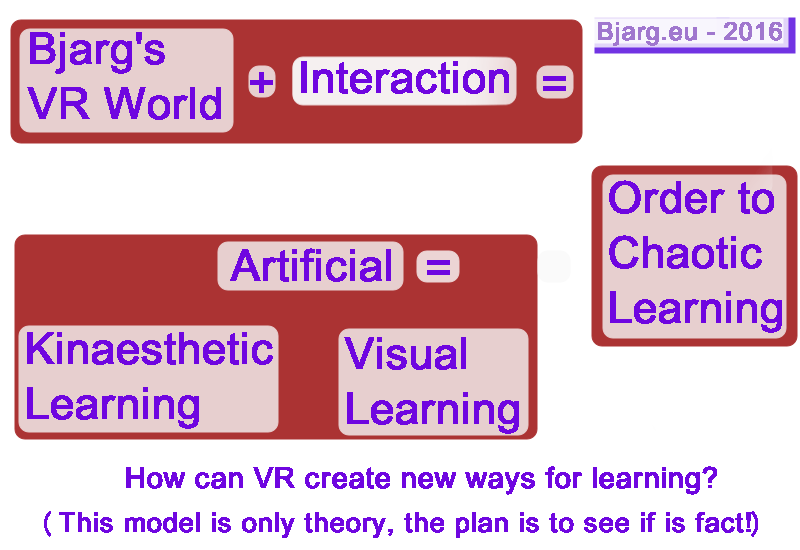
What am I leading to? I have claimed that the purchase of the DK1 was to follow up on this idea. What if the learning can still come from interaction? What if it is a digital pupil they are with, or maybe, a secondary 'real' person in the world with them. How about Autism? The dawn of the VR room will help this, many academic institutions are seeing to this as I type. Think about the possible formula:
My Model for VR in the New Learning:

I write now, in the hope that you might be a part of this. Someone who can supply ideas and be a part of a new way of using VR. One that can help us, rather than give the doubters more ammunition to slam the digital industries down.
I certainly don't believe that anyone will take the industry down, the matter is to big for even the strongest of politicians to effect. What about laws though? Where could they go with the obesity 'crisis'? They may use this as an excuse to outlaw games or even administer new rules for schools. We need to act now, with great effect, and with the an eye on drawing those that don't believe, to see a balance.
Nothing is ever 100% bad. We can be the ones to find the good and use it to support a better future.
I have been working in schools for more than ten years. I have noticed that the general thoughts regarding STEM, at least in the UK, is that it is a 'bit-on-the-side'. It bears no real importance in general learning as a whole. Split down into Maths, and then the other bits, it then becomes something important. Maths being the captain within a metaphorical ship's crew of four.
This brings me onto my point! Although Maths is of great importance, I am not sure that shunning the STE is such a good idea. In the past twelve months, Science has returned to being a core subject in UK Primary education. Engineering and Technology remain on the back burner, showing up in Design and IT across, but not exclusively in the classroom topic. As a nation, and I believe as a global society, we are short of people who can fill these skilled posts. We need to build! We need to create! We need to expand and become better humans!
I'm not saying that engineering will solve the ultimate issues that humanity is facing, but we can get close enough to make a difference!
Enough of this rant, less of the crumbs and more of the biscuit. We have been told that games are bad for us, they cause violence etc. Is this really true? There are many that argue every day of the year over this question. What is most apparent, is that games are fun and hold a hidden gateway to learning. We have many educational opportunities online, ones that are digitally ready for us and that children are eager to learn from. Why can't we extend this? The thought that a game can become a valuable asset to the classroom is a belief that I have long held. I want to find a way that children of all abilities can find this accessible.
As a teacher by profession, I notice that there are pupils that don't listen. They don't want to know the theory behind a number sequence, or the outcome of an experiment. However, show them a BBC Bitesize mini-game, and BOOM, they want a part of it.
Many might argue that this is due to the fact that they spend most of their time on screens, not going out, not interacting. What if interaction is the key? Mixing the concept of learning through a virtual environment could be the key to the gate. This was the purpose behind Bjarg.eu. I wanted to find a 'digital' approach to learning, helping people to 'Reach Their Peak!'
(Bjarg - Translation: https://glosbe.com/is/en/bjarg This tells you the rough translation from Icelandic, but is also said to be that of a mountain.)
I have been into Virtual Reality since the early 90s. I was obsessed with the launch of the VFX1. A headset that is somewhat crude by HTC or Oculus' standards. It was amazing, though it was not bought by many. The idea of the 'Virtual-World' died off very quickly. The release of movies such as The Lawnmower Man, tried to keep the dream alive, but alas, it wasn't to be. Once Oculus released the idea of a new wave of technology, I was on board. I pre-ordered my Oculus DK1 with pride.
One of my later forays into VR, was with a new system that hoped to make it big. It was called VRML, and was set to be used extensively online. It was a great idea and was easy to construct, it was not disimillar to '3D Construction Kit' that I used to build with on my C64. Look at VRML some more, the concept was interesting, but there was very little hype about it overall. There are still some that play about with it, though when did the term 'VRML' last show up in the modern era?
What am I leading to? I have claimed that the purchase of the DK1 was to follow up on this idea. What if the learning can still come from interaction? What if it is a digital pupil they are with, or maybe, a secondary 'real' person in the world with them. How about Autism? The dawn of the VR room will help this, many academic institutions are seeing to this as I type. Think about the possible formula:
My Model for VR in the New Learning:
I write now, in the hope that you might be a part of this. Someone who can supply ideas and be a part of a new way of using VR. One that can help us, rather than give the doubters more ammunition to slam the digital industries down.
I certainly don't believe that anyone will take the industry down, the matter is to big for even the strongest of politicians to effect. What about laws though? Where could they go with the obesity 'crisis'? They may use this as an excuse to outlaw games or even administer new rules for schools. We need to act now, with great effect, and with the an eye on drawing those that don't believe, to see a balance.
Nothing is ever 100% bad. We can be the ones to find the good and use it to support a better future.
Tuesday, 11 October 2016
Exploration - My Theory of the Future and Earth's Mere Mortals!
Where can we go now?
 Besides the obvious exploration to space, where is there to go? I have long felt that I was born in the wrong era! I love the thought of exploration, seeing things first and being there to absorb the local cultures. Imagine sitting on the aft deck of the Beagle with Darwin, or with Scott in Antarctica? Okay, he did die, but what an adventure!
The story of exploration appears to be over! We know all, and have seen it too! With space getting slowly smaller, this looks to be the only sanctuary for the 'Scott-like' people that want that sort of thing. There is one other place though, the ocean! There are a handful of people that are trying new depths, but these, not unlike the space race, are playing a very expensive game. Granted, people of history's explorations, needed to be given the funds from wealthy benefactors. Most needed a passage too, whether is was by ship or over land on a horse! As a mere mortal, I can't afford to go into space, or research the Mariana Tench. What can I do to aid in new discoveries? Very little it seems.
Is this really true?
Exploration can come in many guises. We can look for new lifeforms in our solar system, dive to extraordinary depths to find a new species of venomous sea-snake, or simply explore the Internet. We have been doing this for almost twenty-five years now. I loved being a part of the Internet as it began in the UK. From 1993 onward became the dawn of a brand-new way of getting information, there was, of course, also other things people liked to look at. With a 14.4 modem at my side, I was hooked!
It took a while for the public to catch on, but look at it now! A mangled mess of perverseness and criminal activity. Well, not exactly, this is a tiny part of it. I remember that the news 'never' mentioned the good side of of the Web, this was in the late 90s, it always got under my skin, feeding the public with dread that wasn't always necessary!
What is my theory on this then?
Is domestic exploration really dead? To an extent, yes. Take, for instance, if I want to construct a new idea, I am under the pressure of it having gotten marginally harder to think of something fresh. If you are lucky enough to have that banging idea, it is relatively easy to get people to see it, though other, not so fresh ideas, cover up a lot of the greatness that many will eventually miss. If we think about all media at this moment in time, there are a lot of ideas that are simple rehashes! We are making more covered movies and films than ever before. I can't attribute this to the common plight of depression in society, but I do believe my theory can make a link to it.
As we are stuck in the realms of social media, dwindling the hours away, trying to be unique and let people know what we really think of the meal that we just ate, we are bound to a screen that is more often that not, indoors. We may feel that exploring is gone, but the overall problem is perhaps in our new societal values. I am certain, that with little money, there are still places you can be the first to see, things to create and ideas to coax too. Could you be the first to build a drive that powers a real hovering car? It is the man-in-the-shed that bolsters my theory. As a Brit, one thing that I am proud of, is the men-in-their-sheds! An evolutionary set of home-bound geniuses that created such delights as the wind-up radio and the Stylophone! These aren't big, I know, but in modern times, men around the world are in their sheds, they are creating elevators to the sky and building sources of fossil fuel from the sun!

I put it to you, that these people keep the gates open for exploration, take their side and invent! Invent that new technology that will once again take us to places that we have never seen. Be the person that helps prove the existence of ancient life on our moon. This is going to be fun!
 Besides the obvious exploration to space, where is there to go? I have long felt that I was born in the wrong era! I love the thought of exploration, seeing things first and being there to absorb the local cultures. Imagine sitting on the aft deck of the Beagle with Darwin, or with Scott in Antarctica? Okay, he did die, but what an adventure!
The story of exploration appears to be over! We know all, and have seen it too! With space getting slowly smaller, this looks to be the only sanctuary for the 'Scott-like' people that want that sort of thing. There is one other place though, the ocean! There are a handful of people that are trying new depths, but these, not unlike the space race, are playing a very expensive game. Granted, people of history's explorations, needed to be given the funds from wealthy benefactors. Most needed a passage too, whether is was by ship or over land on a horse! As a mere mortal, I can't afford to go into space, or research the Mariana Tench. What can I do to aid in new discoveries? Very little it seems.
Is this really true?
Exploration can come in many guises. We can look for new lifeforms in our solar system, dive to extraordinary depths to find a new species of venomous sea-snake, or simply explore the Internet. We have been doing this for almost twenty-five years now. I loved being a part of the Internet as it began in the UK. From 1993 onward became the dawn of a brand-new way of getting information, there was, of course, also other things people liked to look at. With a 14.4 modem at my side, I was hooked!
It took a while for the public to catch on, but look at it now! A mangled mess of perverseness and criminal activity. Well, not exactly, this is a tiny part of it. I remember that the news 'never' mentioned the good side of of the Web, this was in the late 90s, it always got under my skin, feeding the public with dread that wasn't always necessary!
What is my theory on this then?
Is domestic exploration really dead? To an extent, yes. Take, for instance, if I want to construct a new idea, I am under the pressure of it having gotten marginally harder to think of something fresh. If you are lucky enough to have that banging idea, it is relatively easy to get people to see it, though other, not so fresh ideas, cover up a lot of the greatness that many will eventually miss. If we think about all media at this moment in time, there are a lot of ideas that are simple rehashes! We are making more covered movies and films than ever before. I can't attribute this to the common plight of depression in society, but I do believe my theory can make a link to it.
As we are stuck in the realms of social media, dwindling the hours away, trying to be unique and let people know what we really think of the meal that we just ate, we are bound to a screen that is more often that not, indoors. We may feel that exploring is gone, but the overall problem is perhaps in our new societal values. I am certain, that with little money, there are still places you can be the first to see, things to create and ideas to coax too. Could you be the first to build a drive that powers a real hovering car? It is the man-in-the-shed that bolsters my theory. As a Brit, one thing that I am proud of, is the men-in-their-sheds! An evolutionary set of home-bound geniuses that created such delights as the wind-up radio and the Stylophone! These aren't big, I know, but in modern times, men around the world are in their sheds, they are creating elevators to the sky and building sources of fossil fuel from the sun!

I put it to you, that these people keep the gates open for exploration, take their side and invent! Invent that new technology that will once again take us to places that we have never seen. Be the person that helps prove the existence of ancient life on our moon. This is going to be fun!
Subscribe to:
Posts (Atom)